


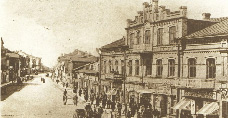
 Panevėžys was established in the old plain of the River Upytė, known in the history since the 13th century. At the time this land was heavily devastated by Livonian wars. There were no towns in this border line region. The region saw a massive influx of inhabitants after the wars with Livonian Order were over. In the second half of the 15th century the number of inhabitants increased immensely. Many of today’s cities and towns in North Eastern Lithuania were established in the beginning of the 16 th century. The city of Panevėžys was also founded in the 16th century. The Grand Duke of Lithuania Alexander's letter, dated September 7, 1503 is the oldest document where Panevėžys is mentioned. The document says that the Grand Duke donates the lands between the rivers Lėvuo and Nevėžis to the vicar of Ramygala, on condition that a church has to be built in this territory. The church clearly had to be a powerful tool to fight against pagan religion which was prospering at the time. A small wooden church and a parsonage were built on the right bank of the river Nevėžis (where crossroads of Senamiesčio and Venslaviškio streets are situated today). The church faced the Market Square and an inn with a bath-house. The settlement later became known as Old Panevėžys.
At the beginning of the 16th century the settlement on the left bank of the river Nevėžis was established. It was called New Panevėžys. The settlement was developing at a quick pace and soon outdid the Old Panevėžys settlement. Local people had their allotments around the triangular Market Square (today - Laisvės Square). It is presumed that in mid 16th century approximately 350 inhabitants lived in the settlement. Their main occupation must have been agriculture, although it is presumed that there were also a number of craftsmen. Considering the size and social economy of that time Panevėžys was an average-sized town in Lithuania. Administration reforms which took place in 1565-1566 transferred Panevėžys into the centre of the region which triggered further developments of the town.
The 17th and 18th centuries, with constant wars, epidemics and starvation, did not contribute much to the town’s growth. It was not until 1614 when the first brick building, Archives of the Court of Justice, was built. In 1727 Pior monks settled in the town and soon afterwards opened the first secondary school, which became a college. The size of the college was not as big as Kražiai or Vilnius College, however, it became the centre of education in the region. In the second half of the 18th century Panevėžys which still remained in the hands of private owners gained several benefits, and according to some indirect sources in 1791-1792 the town was granted autonomous self rule of the city. At the time Panevėžys was seen both as a town and as a city. In the 19th century Panevėžys clearly developed into a city.
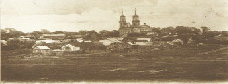 The 19th century with its economic and political stability allowed Panevėžys to continue developing. During this century the city suffered some minor damage only three times - once during the Napoleonic wars in 1812 and twice during the uprisings of 1831 and 1863. In 1811 Russian government bought Panevėžys from its owners, which led to a great economic and political improvement. The following two centuries brought prosperity to the city. The number of inhabitants dramatically increased and economy, infrastructure, social sphere and culture blossomed.
In 250 years, the number of people in Panevėžys doubled. According to some estimates at the beginning of the 19th century there must have been approximately 800 inhabitants. After 1825 the number of inhabitants started to increase. The process was not gradual but continual. In 1897 there were 13 000 people living in the city. The remarkable fact is that the number of inhabitants increased by 16 times in the period of 100 years.
The Industrial Revolution had an impact on the city at the end of the 19th century.The first modern companies were established, industry began to use machinery which affected the whole of manufacturing. The products where oriented towards the mass market.
Banking intensified, trade increased, traders saw no fear of either volume or distance. In the social field, castes become almost extinct. Lithuanian, Polish and Jewish ethnic movements were active in the city. The education system became more accessible, and so the number of literate people increased.
The beginning of the 20th century was characterized by the dawn of civil society. Apparently the end of the 19th century - the beginning of the 20th century shaped Panevėžys as it is nowadays - a strong economic and cultural centre of the region. At the time Panevėžys was the fourth most important city in Lithuania.
During the Interwar period (1918- 1939), Panevėžys continued to grow. With further developments in economy, education and culture, its area increased as well as the number of inhabitants. Between 1923 and 1939 the number of people in Panevėžys rose from 19 200 to 26 000. During this period the number of Lithuanians in the city increased. Although there were only 53 % of Lithuanians in 1923, they became the dominant power in the city. The state, government institutions and most importantly the education system promoted Lithuanian way of life. Polish and Jewish ethnic groups also had an impact on social life in the city.
World War II put Panevėžys through a painful experience. On June 15, 1940 Russian military forces took over the city. The Soviet terrorist acts shocked the citizens: on June 25, 1941 doctors S. Mačiulis, J. Žemgulis, A. Gudonis and a nurse Z. Kanevičienė were brutally tortured and murdered. A number of political prisoners were murdered near the Sugar Factory. A great number of Panevėžys people were exiled to Siberia or suffered from repressions.
During German occupation, more than 8 000 local people, the majority of whom were Jews, were murdered.
After the World War II natural processes of the city evolution were disrupted. The Soviet Communist Party hold everything in its sphere of influence. The city was made a major industrial centre. During the 60s and 80s several large-scale industrial companies were established. Therefore, the number of inhabitants increased on a larger scale. Between 1959 and 1979 the number of Panevėžys people rose from 41 000 to 101 500, in 1990 the population was 130 000. With the rise of the number of inhabitants, city area increased as well. In the 70s the municipality started to renovate the city centre and clean the river Nevėžis.
In 1990, after Lithuania regained its independence, the country began a rapid integration into modern European community. This integration is taking place in a number of ways. It is apparent in people's way of thinking, mentality and customs as well as country’s economy, culture and education. However, it was the city’s industry which saw the major challenge. In a very short time it had to be restructured and adopted to conditions dictated by post industrial society. In spite of evolution of the past decade, Panevėžys remains essential centre of the region, and for more than a century it has been the fifth major city in Lithuania.